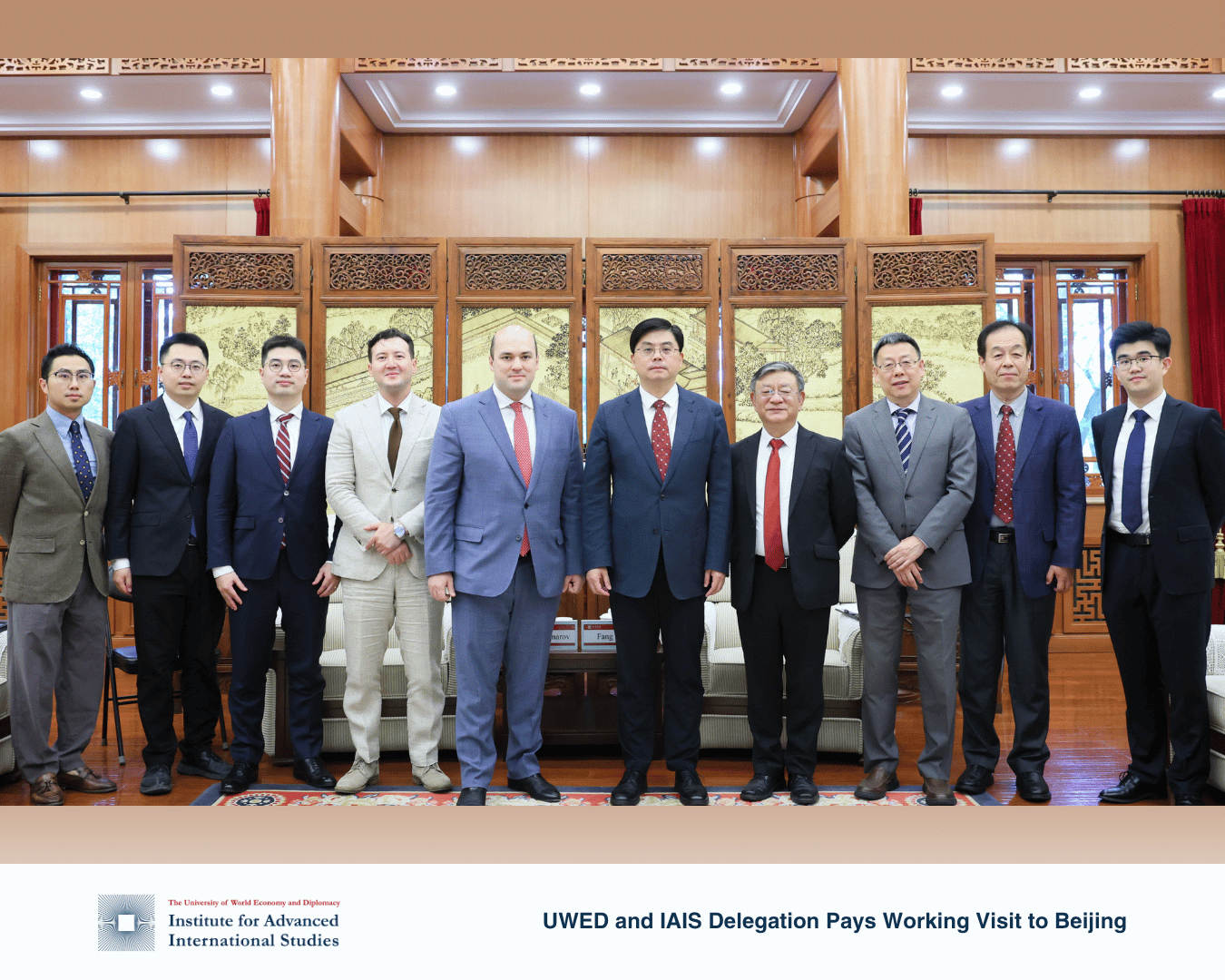
From June 9 to 10, First Vice-Rector of UWED and Director of IAIS Dr. Akram Umarov, and the Deputy Director of IAIS Odil Gafarov and IAIS Associate Research Fellow Noah Gao paid a working visit to Beijing to develop practical avenues for academic and expert cooperation with leading Chinese institutions. The programme included meetings with leading Chinese universities and analytical centres, namely Peking University, Tsinghua University, Minzu University, and the Beijing Club for International Dialogue. The discussions focused on identifying formats of cooperation, shaping a substantive agenda for further engagement, and preparing institutional mechanisms for long-term collaboration.
At Peking University, the talks were held with Fang Fang, Vice President; Tang Shiqi, Dean of the School of International Studies; Fan Shiming, Dean of the Yenching Academy; Shi Yue, Associate Professor and Director of the Center for Central Asian Studies; and Cui Zhe, Deputy Director of the Office of International Relations. The parties discussed the development of cooperation in Chinese and Central Asian studies, international studies, regional development, public administration, economic development, sustainable development, energy security, and economic diplomacy. Particular attention was paid to possible cooperation with the Center for Central Asian Studies and the School of International Studies, as well as to the participation of young scholars in summer and winter schools on Central Asia. A memorandum of understanding has been signed between IAIS and the School of Foreign Languages at Peking University, providing a framework for regular exchanges, joint research initiatives, academic publications, conferences, seminars, workshops, and research fellow and doctoral student exchange programmes
At Tsinghua University, the delegation met with Yang Bin, Deputy Chairperson of the University Council; Tang Xiaoyang, Professor and Chair of the Department of International Relations; Liu Nannan, Deputy Dean of the Office of International Affairs; and Wang Tao, Assistant Professor at the Institute of International and Regional Studies. The discussions focused on academic exchanges, short-term programmes introducing foreign students to contemporary China, cooperation in international relations and regional studies, and research on Central Asia, China, the Asia-Pacific region, modernisation, economic reforms, poverty reduction, agricultural transformation, and China’s experience in public administration. The parties also considered opportunities for cooperation in executive education and the gradual formation of a more sustainable research platform on China and China–Central Asia relations. A memorandum of understandinghas been signed between IAIS and the Department of International Relations at Tsinghua University, establishing an institutional basis for mutual visits, exchange of experience and academic publications, joint research, conferences, seminars, presentations, workshops, capacity-building programmes, and doctoral student and research fellow exchanges.
At Minzu University, the delegation met with Qiang Shigong, President of the University; Peng Yong, Member of the Standing Committee of the University Party Committee and Vice President; Zhang Yan, Director of the Department of International Cooperation; Zhang Ming, Deputy Director of the Institute of Regional and Country Studies and Deputy Dean of the School of Ethnology and Sociology; Gulibanu Mu Kebaituly, Deputy Dean of the School of Foreign Languages and the Institute of Regional and Country Studies; and Che Chang, staff member of the Office of International Affairs. The meeting focused on cooperation in the study of Uzbekistan, Central Asia, China, and China–Uzbekistan relations. The parties discussed prospects for joint analytical reports, including possible publications on China–Uzbekistan relations and an annual report on Uzbekistan’s development covering political, economic, diplomatic, social, and cultural aspects. Special attention was also given to language cooperation, the study of Uzbek, Chinese, and Russian, as well as comparative research on ethnic policy, national identity, interethnic harmony, culture, religion, and regional development.
A separate meeting was also held with Helen Han, Co-founder and Director of the Beijing Club for International Dialogue. The sides discussed opportunities for cooperation in open and closed expert dialogues on current international and regional issues. Particular attention was paid to the possibility of developing expert formats involving representatives of Asia, Central Asia, China, Russia, Europe, and the United States, with a view to strengthening independent regional perspectives in discussions on global security and international affairs.


