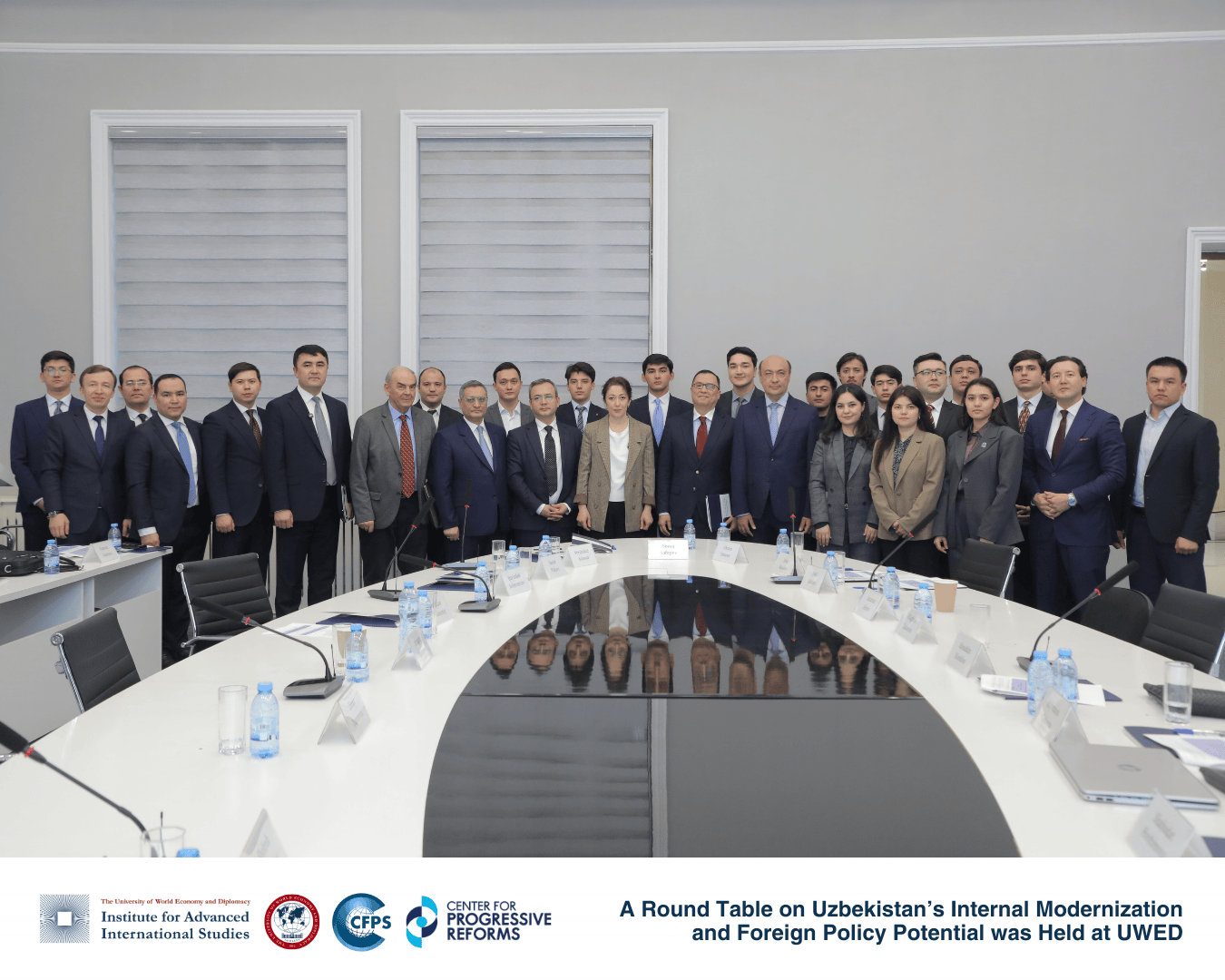
On January 16, the University of World Economy and Diplomacy hosted a round table on the topic of “Internal modernization and foreign policy potential of Uzbekistan: economic transformation, human capital development, and strengthening of international positions”. The event was devoted to a comprehensive expert analysis of the provisions of the Address of the President of the Republic of Uzbekistan Shavkat Mirziyoyev to the Oliy Majlis and the people of Uzbekistan dated December 26, 2025, in which the internal modernization of the country was identified as a key source of its foreign policy subjectivity. The round table was organized by the University of World Economy and Diplomacy, the Institute for Prospective International Studies (IPMI), the Center for Progressive Reforms (CPR), and the Center for Foreign Policy Studies (CFPS) under the Ministry of Foreign Affairs of the Republic of Uzbekistan.
Opening the event, Sodyq Safoev, First Deputy Chairman of the Senate of the Oliy Majlis of the Republic of Uzbekistan, Rector of UWED, Mirshokhid Aslanov, Director and Co-founder of the CPR, and Sanjar Valiev, Director of the CFPS, emphasized that the current stage of Uzbekistan’s development is characterized by a transition from the logic of internal reforms as a purely socio-economic process to their perception as a tool for strengthening the state’s international position. In this context, the round table became an expert platform for discussing how economic transformation, human capital development, institutional sustainability, and social well-being can be converted into a long-term foreign policy resource for the country.
The first session was directly related to the theses of the President’s Address on the growing role of Uzbekistan as an international dialogue platform and an active participant in global and regional processes. The discussion focused on issues of institutional effectiveness, governability, and strategic stability of the state as the basis for a proactive and balanced foreign policy. Participants noted that the successful hosting of major international events in Uzbekistan and the expansion of the country’s diplomatic geography confirm the direct link between the quality of public administration and the level of foreign policy trust.
The second session was devoted to the economic dimension of modernization, which the President’s Address identified as one of the key factors of national power. Experts discussed the macroeconomic achievements of recent years, including gross domestic product growth, improvement of the investment climate, and development of entrepreneurship, emphasizing that economic stability forms the material basis for foreign policy autonomy. During the discussion, it was noted that a competitive economy strengthens Uzbekistan’s negotiating position and expands its international maneuvering space.
The third session logically continued the provisions of the President’s Address on human capital as a strategic resource for the development of the “New Uzbekistan”. The discussion focused on issues of education, science, social mobility, and youth engagement. Participants emphasized that investments in human and social capital not only contribute to the internal stability of society but also shape the country’s positive international image, strengthening its “soft power” and attractiveness on the global stage.
In conclusion, the roundtable participants agreed that the President’s Address set out a comprehensive strategic framework in which internal modernization and foreign policy are seen as complementary elements of a single development course. Expert discussions confirmed the relevance of further deepening the analytical dialogue between research institutes, government agencies, and the academic community to develop practical recommendations for strengthening Uzbekistan’s international position in the context of a transforming world system.


