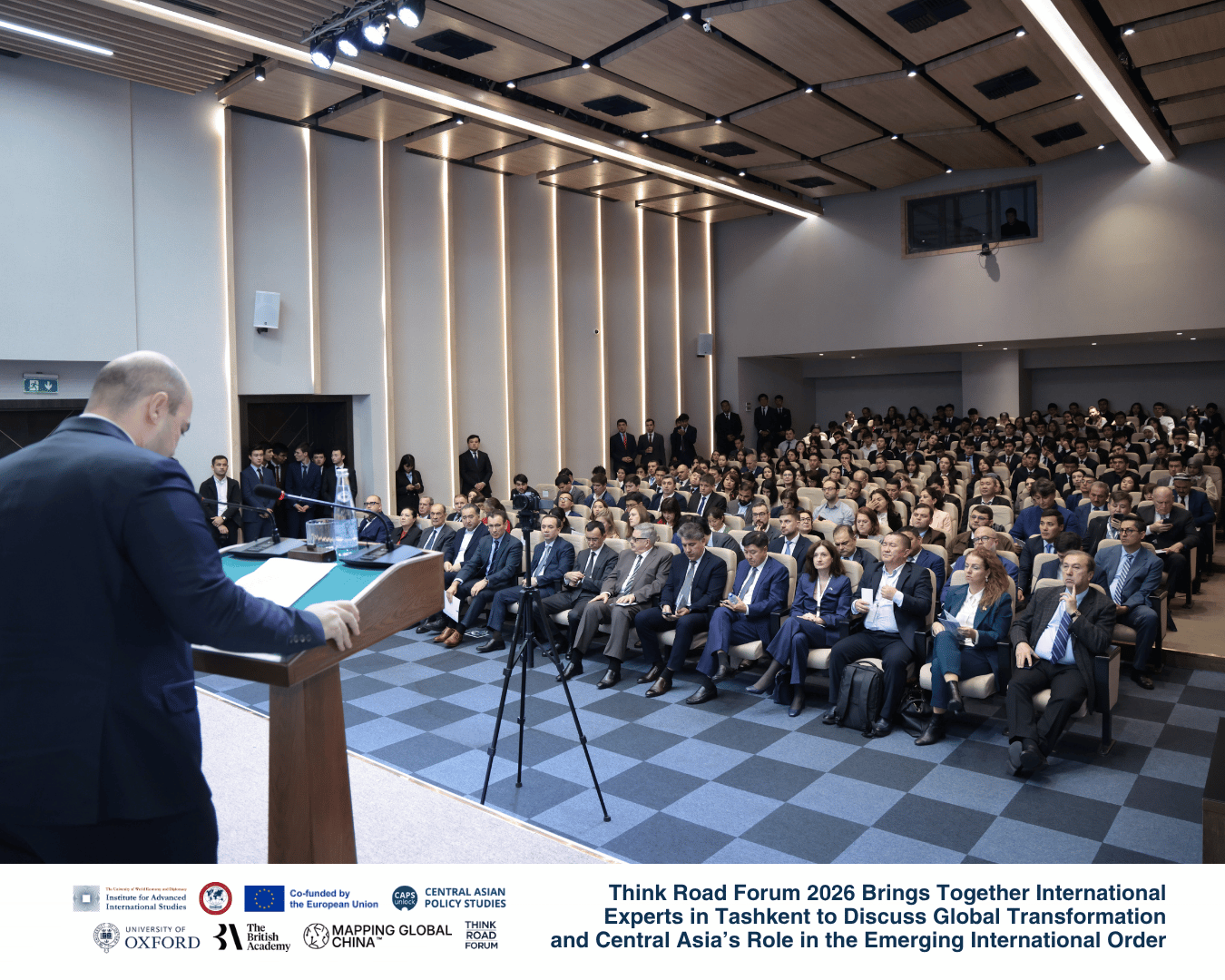
On 4–5 November 2026, the Institute for Advanced International Studies (IAIS) at the University of World Economy and Diplomacy (UWED) hosted the Think Road Forum 2026 in Tashkent under the theme “Global Transformation and Regional Dynamics: Central Asia in the Emerging International Order”. The two-day international forum brought together policymakers, representatives of leading think tanks, international organisations, academic institutions and research centres to examine the evolving global political and economic landscape and its implications for Central Asia.
Held against the backdrop of intensifying geopolitical competition, geoeconomic fragmentation and growing uncertainty surrounding established mechanisms of international cooperation, the Forum provided a platform for exchanging perspectives on the transformation of the international order. Particular attention was devoted to Central Asia’s increasing geopolitical and geoeconomic significance, the strengthening of regional cooperation and the opportunities for the region to exercise greater agency in international affairs.
The Forum opened with welcoming remarks by Dr. Akram Umarov, First Vice-Rector for Academic Affairs of UWED; Mr. Maulen Ashimbaev, Chairman of the Board of Trustees of Taldau AI Analytics; Ms. Renata Wrobel, Deputy Head of Mission of the Delegation of the European Union to Uzbekistan; Dr. Maria Adele Carrai, Associate Professor at the University of Oxford; and Mr. Askar Kushkunbayev, Senior Grants Manager at CAPS Unlock. It was followed by a keynote address delivered by Mr. Javlon Vakhabov, Deputy Advisor to the President of Uzbekistan and Director of the International Institute for Central Asia.
The first day of the Forum focused on the geopolitical transformation of the international system, the growing presence of major powers in Central Asia and the region’s capacity to respond to emerging political, economic and security challenges.
The first panel, “Global Disorder and Regional Responses: Central Asia in the Emerging International Order”, examined the implications of geopolitical rivalry, changes in global governance and evolving international alignments for Central Asian states, with particular emphasis on regional resilience and foreign policy diversification.
Two subsequent sessions, organised in partnership with the British Academy, the University of Oxford and Mapping Global China, explored the presence of major powers in Central Asia and the complex economic and societal dimensions of the region’s engagement with China. These sessions were linked to a forthcoming special issue of the Journal of Current Chinese Affairs.
Bringing together scholars from universities and research institutions across Central Asia, Europe and China, the discussions addressed the expanding role of external actors in the region, infrastructure development, investment patterns and public attitudes towards China’s growing economic presence. Particular attention was given to the ways in which Central Asian governments and societies respond to external initiatives while pursuing their own national development priorities.
Another important component of the first day comprised two panel discussions organised in partnership with the Delegation of the European Union to Uzbekistan.
The session “Strengthening Resilience via Regional Cooperation” examined the importance of regional partnerships, institutional cooperation and effective governance in addressing common challenges. Participants considered how dialogue between governments, international organisations and civil society institutions can contribute to more resilient and inclusive regional development.
The following discussion, “Connectivity in a Fragmenting World: Opportunity or Vulnerability for Central Asia?”, explored the strategic implications of expanding transport corridors, strengthening trade relationships and developing cross-border infrastructure in an increasingly fragmented international economic environment. The session addressed the opportunities and vulnerabilities associated with connectivity initiatives, including the relationship between economic interdependence, external influence and regional strategic autonomy.
The second day of the Forum broadened the discussion to encompass regional identity, sustainable development, trade transformation, technological innovation and the long-term future of Central Asian cooperation.
The programme began with a keynote address by Prof. Timur Dadabaev, Vice-Rector for Research and Innovation at UWED and Professor at the University of Tsukuba, entitled “What Makes Us ‘Us’? Regional Identity and the Future of Central Asia”. The address placed regional identity and shared historical and societal experiences at the centre of discussions about the prospects for deeper cooperation among Central Asian countries.
The second day included the launch event of the United Nations Sustainable Development Solutions Network (SDSN) Uzbekistan, organised in partnership with SDSN Uzbekistan. The session introduced the network’s vision, priorities and opportunities for advancing research, institutional collaboration and evidence-based approaches to sustainable development. The launch provided an opportunity to discuss mechanisms for strengthening cooperation among academic institutions, research organisations and development stakeholders in support of sustainable development priorities.
Building on these discussions, the panel “Building a Sustainable Central Asia: Climate, Resources, and Resilience” explored the interconnected challenges of climate change, natural resource management and sustainable economic development. The session brought together experts and representatives of international organisations to consider the importance of coordinated regional responses to environmental pressures, particularly in areas such as water governance, climate adaptation and resource security.
Economic transformation and the changing patterns of regional trade were examined during the session “Foreign Trade in Central Asia: Transformation or Status Quo?”, organised in partnership with CAPS Unlock. Participants discussed the evolving structure of Central Asian trade, opportunities for economic diversification, the development of regional value chains and the implications of global supply-chain restructuring for the region’s future competitiveness.
Technological transformation was another prominent theme of the Forum. The panel “AI and the Future of Statecraft: What It Means for Central Asia?”, also organised in partnership with CAPS Unlock, explored the growing influence of artificial intelligence on public administration, governance and policymaking.
Bringing together representatives of government institutions, technology companies, research organisations and civil society, the session examined the opportunities associated with AI-driven innovation, alongside emerging challenges related to digital governance, institutional preparedness and the responsible adoption of new technologies.
The Forum concluded its thematic programme with the forward-looking session “Central Asia 2030: Stability, Fragmentation, or Strategic Consolidation?”, which examined possible trajectories of regional development over the coming years. Experts considered the prospects for strengthening regional cooperation, the implications of intensifying geopolitical competition and the ability of Central Asian states to consolidate their collective position in an increasingly complex international environment.
By convening representatives of government institutions, academia, international organisations and the expert community, the Think Road Forum 2026 reinforced the importance of sustained intellectual exchange and policy-oriented dialogue in addressing the challenges of global transformation.
Through initiatives such as the Think Road Forum, IAIS continues to promote Tashkent as a platform for international expert dialogue, interdisciplinary research and constructive engagement on the most pressing issues affecting Central Asia and the wider international community.


