Conferences

outputs_in

Conferences

16 January, 2026

The Renewable Energy Chessboard: Central Asia between China, Russia and the EU

In their article, published by Rosa Luxembourg Foundation’s Representative Office in Central Asia as proceedings of the international conference on “Central Asia in the Face of Global Economic Transformation: Assessment and Forecasting”, organized jointly with UWED, Ubaydullo Khujabekov and Ashwin Raghuraman examine how renewable energy has become a strategic arena in which Central Asian states navigate competition among major external actors. The authors argue that green energy is no longer merely a developmental priority, but a geopolitical instrument through which countries such as Uzbekistan, Kazakhstan and Kyrgyzstan seek to diversify partnerships, strengthen sovereignty and reduce long-standing structural dependencies. The article contrasts the approaches of the three key players shaping the region’s energy landscape. Russia and China are portrayed as providers of immediate, tangible solutions through legacy infrastructure, fossil fuel supplies and fast-moving investment projects, albeit at the cost of deepening dependency. By contrast, the European Union advances a longer-term, governance-oriented model under initiatives such as Global Gateway, linking renewable energy investment with regulatory reform, transparency and sustainable development standards. Ultimately, the authors show that Central Asian states are not passive objects of great-power rivalry. Instead, they actively balance these competing offers, leveraging renewable energy to pursue a multipolar energy future that enhances resilience, policy autonomy and regional cooperation. The article positions green energy as a key strategic lever through which Central Asia can redefine its role in the evolving Eurasian and global order. * The Institute for Advanced International Studies (IAIS) does not take institutional positions on any issues; the views represented herein are those of the author(s) and do not necessarily reflect the views of the IAIS.

outputs_in

Conferences

16 January, 2026

Overall Assessment of Global Challenges to Security and Stability in Central Asia

In an article by Rustam Makhmudov, Leading Research Fellow at the Laboratory of Anthropology and Conflict Studies, published in a collection of materials from the international conference “Central Asia Facing the Challenges of Global Economic Transformation: Assessment and Forecasting”, organized by UWED in partnership with the Rosa Luxemburg Foundation’s Representative Office in Central Asia, offers a comprehensive interpretation of global challenges to security and stability in Central Asia in the period up to 2030–2040 through the prism of Giovanni Arrighi's theory of systemic cycles of capital accumulation. The author proceeds from the thesis that the modern world system is undergoing profound structural transformations associated with the weakening of American hegemony, increased competition between the US, China, the EU, and the countries of the Global South, as well as the acceleration of the Fourth Industrial Revolution. The article pays particular attention to the analysis of US policy, primarily during Donald Trump's presidency, which the author views as an attempt to prevent the transition of the American accumulation cycle from a “signal” to a “terminal” crisis. To this end, Makhmudov uses three analytical indicators, “profit norm,” “Lippmann gap,” and “determination indicator”, to assess the ratio of US resources to global obligations, the level of their institutional stability, and their capacity for structural economic restructuring. It is shown that the growth of financialisation, public debt and foreign policy commitments increases the risks of systemic turbulence at the global level. In the regional dimension, the author emphasizes that the key threats to Central Asia are the vulnerability of logistics and trade chains, a possible shift in the balance of external forces, risks of destabilization in the security sphere (including those related to the situation in Afghanistan), and restrictions on access to advanced technologies. At the same time, the weakening of the dominant center of the world system opens new opportunities for the countries of the region, primarily to strengthen their own agency, deepen regional consolidation, and position themselves more flexibly in the emerging multipolar order. Rustam Makhmudov concludes that the stability and security of Central Asia in the context of global transformations will depend on the ability of the countries of the region to combine a strategy of balancing external actors with the development of their own economic, technological, and institutional potential. Such an approach, according to the author, will not only minimize risks, but also allow the current turning point to be used to strengthen Central Asia's role in the new architecture of international relations. * The Institute for Advanced International Studies (IAIS) does not take institutional positions on any issues; the views represented herein are those of the author(s) and do not necessarily reflect the views of the IAIS.

outputs_in

Conferences

13 December, 2025

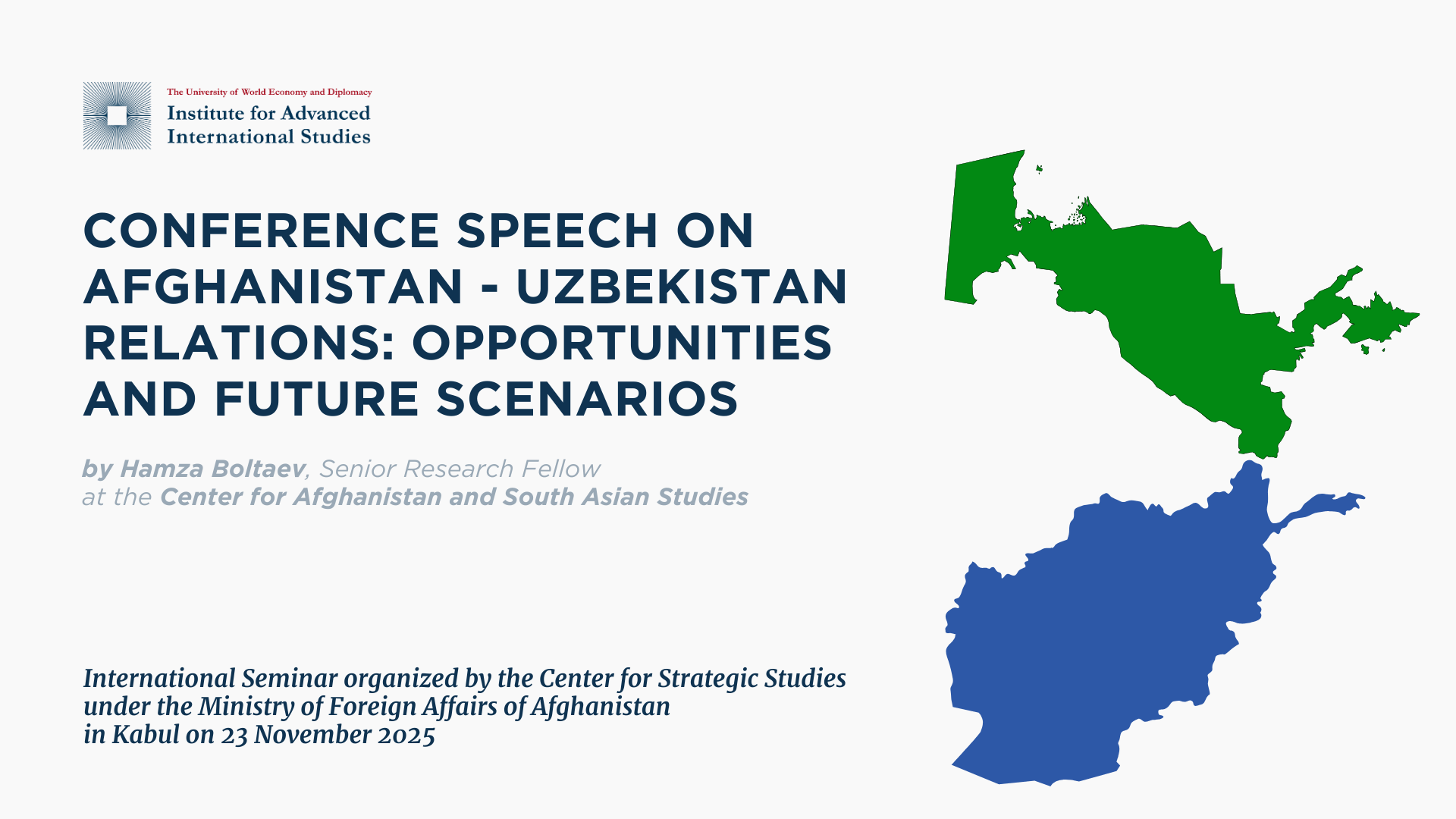
Hamza Boltaev speaks at Kabul seminar on Afghanistan–Uzbekistan relations

Hamza Boltaev delivered a speech at the seminar “Afghanistan – Uzbekistan Relations: Opportunities and Future Scenarios”, organised by the Center for Strategic Studies of the Ministry of Foreign Affairs of Afghanistan in Kabul on 23 November. The discussion brought together ministry staff and experts to exchange views on the future of bilateral ties and practical areas for cooperation. In his remarks, Mr. Boltaev emphasised the value of regular expert dialogue and academic cooperation as a steady way to strengthen mutual understanding and develop realistic proposals. He noted that research exchanges, joint seminars, and professional networks can support closer contacts between institutions and help both sides identify shared interests in a calm, constructive format. During the Q&A, participants raised questions about how to make cooperation more convenient in practice, particularly on mobility and travel procedures, as well as trade and cross-border logistics. Mr. Boltaev underlined that some issues are decided at the governmental level, while his own contribution as a researcher is to support partnership through analysis, dialogue, and educational ties that build long-term trust. He also stressed that expanding economic ties works best when it is done step by step, in a way that encourages trade and new opportunities while keeping a sensible balance with domestic priorities. Overall, his speech highlighted a simple message: sustainable Afghanistan–Uzbekistan cooperation grows fastest when it is built on practical communication, gradual progress, and strong links between experts and institutions. * The Institute for Advanced International Studies (IAIS) does not take institutional positions on any issues; the views represented herein are those of the author(s) and do not necessarily reflect the views of the IAIS.
outputs_in

Conferences

08 August, 2025

Challenges and Opportunities for Revitalizing Southern Transit Routes for Central Asia

A paper by Nargiza Umarova has been published in a collection of materials from the international scientific and practical conference “Geopolitics of Logistics: Transport Corridors of Central Asia in the Global System”, held on April 4, 2025, by the Faculty of International Relations of Al-Farabi Kazakh National University (Almaty), in which she analyzes the challenges and opportunities for activating the southern transit route for Central Asia, considering projects through Afghanistan as a tool for diversifying foreign trade routes and reducing dependence on the northern route through Russia. Considerable attention is paid to Iran's role in providing Central Asia with access to Indian Ocean ports, as well as the Taliban government's efforts to transform Afghanistan into an interregional transport hub.   An article examines in detail key infrastructure initiatives, including the Termez-Mazar-i-Sharif-Kabul-Peshawar and Torgundi-Herat-Kandahar-Spin Buldak railway corridors, the Lazurite Route, and the Wakhan Corridor. It analyzes the participation of Russia, China, India, and Iran in these projects, as well as the possible consequences of their geopolitical rivalry for the long-term interests of Central Asian states.   In conclusion, the expert emphasizes the need to develop a unified regional strategy for the development of southern transit, select a priority route that is beneficial to all states in the region, and create a regional investment fund to finance infrastructure projects. In her opinion, coordinated actions by Central Asian countries can strengthen their positions in the global transport and logistics system and turn Afghanistan into a stable link in mutually beneficial cooperation.   * The Institute for Advanced International Studies (IAIS) does not take institutional positions on any issues; the views represented herein are those of the author(s) and do not necessarily reflect the views of the IAIS.
outputs_in

Conferences

27 July, 2025

The Uzbek Diaspora as a Mediator of Social Change: Transcultural Identity and Connection with the Homeland

At the 10th international round table of the Al-Farabi Kazakh National University, Professor Azamat Seitov presented a report on “The Uzbek diaspora as a mediator of social change: Transcultural Identity and Connection with the Homeland”, in which he outlined a conceptual framework for understanding the diaspora not as a passive legacy of migration, but as an active and dynamic social organism. According to him, the Uzbek diaspora has a significant impact not only on the countries where they live, but also on Uzbekistan itself, forming a new dimension of transnational partnership.   Professor presented statistical data according to which about 5.5 million Uzbeks live abroad — almost 12% of the country’s population. The leading countries of residence remain Russia, Kazakhstan, South Korea, and Turkey. Seitov emphasized that the high natural population growth in Uzbekistan and the large proportion of young people create the conditions for further growth of the diaspora, including new waves of labor, educational, and family migration. This requires the development of a systematic state policy to include migration and diaspora potential in the national development strategy.   The report paid special attention to transformations within the diaspora itself: from a low-skilled workforce to communities of educated, professional Uzbeks capable not only of economic transfers but also of introducing innovative models of behavior, social norms, and cultural codes. The professor analyzed the experience of the diaspora in South Korea, where the second generation of migrants has successfully adapted, preserving their Uzbek identity while integrating into new cultural environments.   An important topic of the report was the transcultural identity of the diaspora as a result of the complex interaction between the native culture and the culture of the host society. The professor noted that the successful integration of the diaspora is accompanied by the preservation of language, traditions, and social structures, as well as the development of “synergistic” forms of identity. He emphasized the need to maintain ties with the historical homeland, especially with the second and third generations of migrants, through cultural centers, digital platforms, educational programs, and grants.   In conclusion, Professor Seitov emphasized that the Uzbek diaspora is not a drain, but a strengthening of social capital. It can become an important actor in promoting reforms, transferring knowledge and technology, strengthening cultural diplomacy, and developing new models of social interaction. The state should view the diaspora as part of national development, investing in the formation of transcultural competencies in the new generation of Uzbeks.   * The Institute for Advanced International Studies (IAIS) does not take institutional positions on any issues; the views represented herein are those of the author(s) and do not necessarily reflect the views of the IAIS.
outputs_in

Conferences

31 May, 2025

Dr Akram Umarov Delivers Keynote on Central Asia’s Strategic Role at the Asian Leadership Conference in Seoul

On 21–22 May, Dr Akram Umarov, First Vice-Rector for Academic Affairs at the University of World Economy and Diplomacy (UWED) and Director of the Institute for Advanced International Studies (IAIS), took part in the prestigious Asian Leadership Conference (ALC), held in Seoul, and organized by The Chosun Ilbo — South Korea’s most influential national daily newspaper.   Now in its latest edition, the Asian Leadership Conference has grown into Korea’s foremost international forum, convening world-renowned political figures, global business leaders, and leading academics to debate the critical global challenges of our time. With a theme of “The Rise of Nations: Pathways to Great Prosperity”, the 2025 ALC examined transformative national strategies across regions, highlighting innovation, resilience, and geopolitical realignment in an era of heightened global uncertainty.   Dr Umarov was invited as a keynote speaker on the panel “Central Asia at the Crossroads: Geopolitics, Connectivity, and Regional Dynamics”. This timely session explored Central Asia’s evolving role as a pivotal bridge between East and West amid mounting geopolitical shifts and the reconfiguration of global supply chains.   In his keynote address, Dr Umarov provided a compelling analysis of the region’s accelerating regional cooperation, placing particular emphasis on Uzbekistan’s pivotal role in reshaping the regional order. He traced the turning point to the political transformation in Uzbekistan in 2016, which ushered in a new era of constructive diplomacy and de-securitized relations with neighboring states. He further underscored the strategic value of Uzbekistan’s pragmatic approach toward Afghanistan, which has opened opportunities for connectivity and peacebuilding beyond conventional alliances.   Highlighting infrastructure as a cornerstone of regional strategy, Dr Umarov elaborated on initiatives to develop reliable multi-directional transport corridors — linking Central Asia to South Asia, the South Caucasus, and Europe. These efforts, he argued, are positioning the region not only as a geopolitical fulcrum but as an emerging hub of economic integration and sustainable development.   The panel concluded with a dynamic exchange during the discussion session, where Dr Umarov and fellow experts engaged in in-depth discussions on specific challenges and the prospects for deeper regional integration in the face of global uncertainty.   Dr Umarov’s participation in ALC 2025 underscored Uzbekistan’s growing voice in global dialogues and reaffirmed IAIS’s commitment to contributing to the international policy discourse on Central Asia’s transformation and future trajectory.   * The Institute for Advanced International Studies (IAIS) does not take institutional positions on any issues; the views represented herein are those of the author(s) and do not necessarily reflect the views of the IAIS.