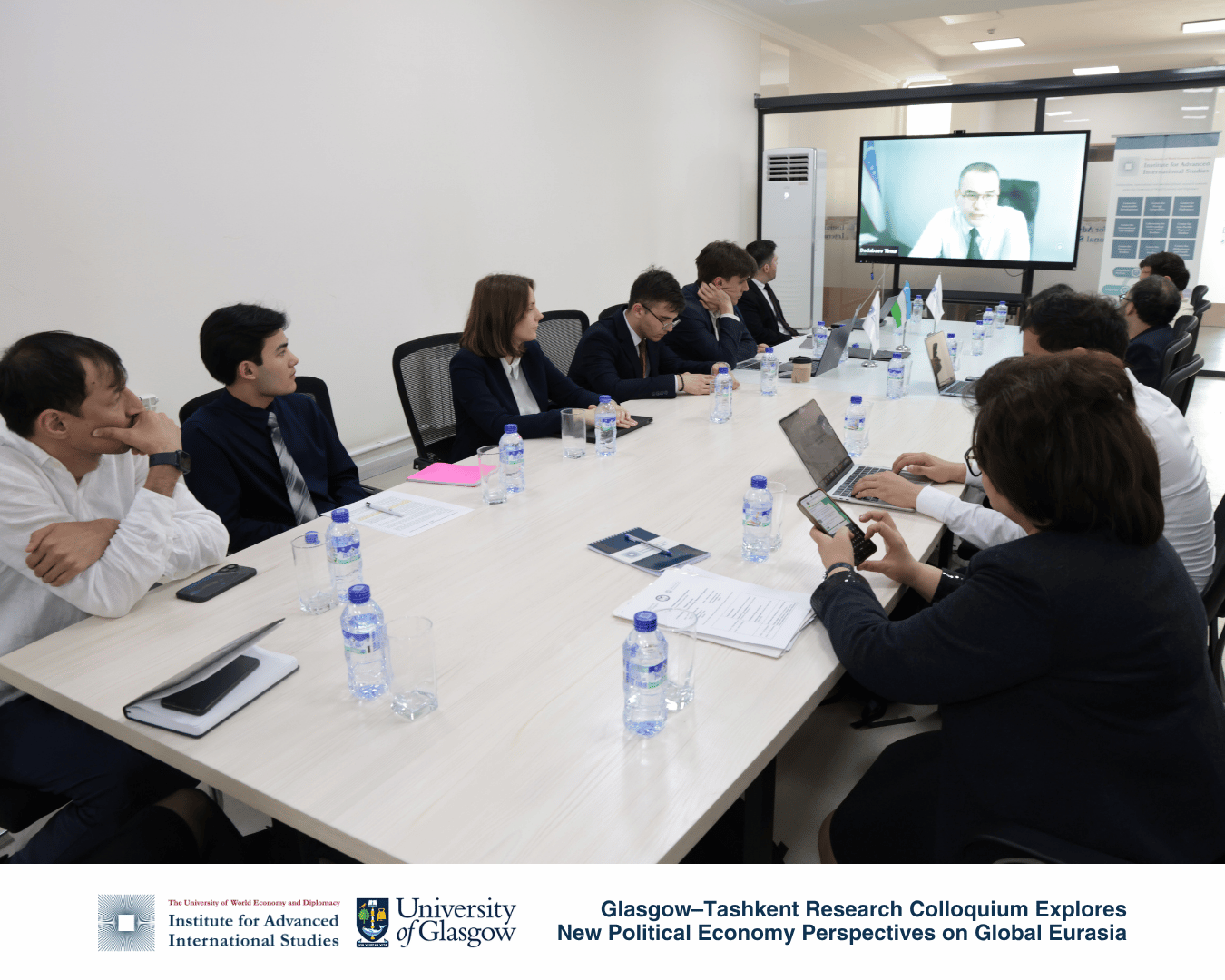
On 30 April, the Glasgow–Tashkent Research Colloquium was held under the theme “Global Eurasia: A Renewed Political Economy Research Prospectus”. The event brought together scholars and researchers from the University of Glasgow, the University of World Economy and Diplomacy (UWED), Institute for Advanced International Studies (IAIS), and partner institutions to discuss the evolving political economy of Eurasia, with a particular focus on Central Asia’s changing regional and global positioning. The colloquium was kindly supported by the University of Glasgow’s MacFie Bequest.
The event opened with remarks by Professor Luca Anceschi of the University of Glasgow and Professor Timur Dadabaev, Vice-Rector of UWED. The concept and agenda of the colloquium were introduced by Matthew Heneghan, postgraduate researcher at School of Social and Political Sciences, University of Glasgow, and Visiting Fellow at IAIS, who outlined the intellectual purpose of the meeting and its role in strengthening research dialogue between Glasgow and Tashkent.
The first panel, titled “New Uzbekistan in a Changing World”, examined Uzbekistan’s regional security approaches, institutional development, economic resilience, and the broader dynamics of political stability and integration in Central Asia. Presentations addressed issues ranging from leadership perceptions and regionalism to the Islamic Civilization Center, the U.S. C5+1 framework, and comparative perspectives on Uzbekistan and Kazakhstan.
The second and third panels broadened the discussion to questions of resources, capital, welfare, migration, and structural transformation. Speakers analysed natural resource funds in Azerbaijan and Kazakhstan, mining and remittances in Kyrgyzstan, rare earth competition in Central Asia, urban shrinkage, the middle-income trap in Uzbekistan, social protection, and the limitations of financial inclusion for migrant households.
The final panel, “Information, Influence and Geopolitics: Narratives Across Eurasia,” focused on the role of strategic narratives, media, and external powers in the region. Presentations explored China’s unconventional military presence, Iran’s geopolitical interests in Central Asia, Chinese economic influence in public perception, and the contestation of liberal norms in the context of shifting global hegemony. The colloquium highlighted next steps for advancing academic cooperation and developing a renewed research agenda on Global Eurasia.


